Thursday, March 16, 2006

In and out of Nepal

As we drove north to Lumbini, Nepal, sickness was coming on far stronger for me. Gilad had to leave our company after Kushinagar and was to meet us in Savastthi. It had just come to his attention that he had purchased a visa with "single entry", being in India a month he had no idea he would want to exit the border and come back. We stopped in one big and ugly and dirty city in the north to let him out. I used a miserable bathroom in a rundown hotel and hobbled back to the bus. As we contined on, the fever was increasing and I was feeling worse-- either the well water or sugar cane juice as far as I could reckon. Kedaar was also having a head cold, and as we were both sitting by Bhanteji, he did a very long chanting, about an hour or so, that filled both of us with metta. Now, even in much pain, there was kind of a joy coming into me as well. We stopped at the Indian border town and it was as chaotic, smog-filled, and hectic as anything you could imagine. Another point here where words fail me-- something out of a thousand years ago here. As we walked along, we had to cover our mouths with a cotton cloth, otherwise it felt like you were taking a container of dirt, dust, and exhaust, and sucking it into the bottom of your lungs. It was even worse than most Indian cities, which are so bad that when you blow your nose it comes out black, or if you scratch your face, a layer of grime peels out from under the fingernail. You can even see Kedaar and Lek having to cover their mouths in this picture below as we stroll into India...


We filled out several forms in the Indian office, walked across to a sign welcoming us to Nepal, filled out more forms at the Nepali office, where we instantly found officials who did not disdain us but actually smiled as we spoke and acknowledged we existed. How nice Nepal was! We were issued a free three day visa and met Mahindra.

A couple more hours into the night we rolled north until we reached the Lumbini Vipassana center (see the photo taken on the following morning here). We were warmly welcomed inside, and as no course was going on, given rooms. I was quite weak by now and praying we would not have the requisite two hours of forms and formalities and chais that very well could take place. Luckily we did not. I managed to make my bed, get a glass of hot lemon water, light the mosquito coils with the worst matches I have ever seen, and slept until our morning meditation in the Vipassana hall.

We walked to the holy site in Lumbini and continued our meditation, chanting, walking, and listening to Bhanteji's Dhamma Talks and stories. At lunch everyone else went outside to find food, and I stayed with Bhanteji in meditation. We saw the pond where Gotama's mother washed after his birth, and saw several hundred white clad Sri Lankans sitting cross legged before it. The Nepali government had built a huge construction protecting the most important ruins, including the 5th Century BCE ruins that marked the original house and even spot where Gotama was born to. We later found out that the Indian government was legally not permitted to make such renovations. Lumbini differed greatly to the Indian sites-- it seemed much better cared for and the central planning of the surrounding areas was very logical and convenient. A trust composed of all the different Buddhist schools worked together to make the plans, and even a Goenka-Vipassana student was a member.

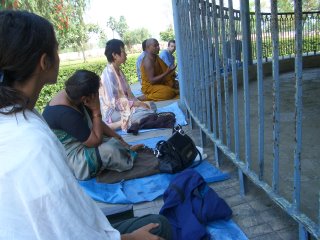
Here are two more photos... the first as we walk after Bhanteji paying homage to the actual birthplace of Buddha by repeating his chanting. The second (below) in the same area, just as we sit down to honor Triple Gem for sitting...


We left Lumbini and I did slowly start to feel better. A sickness that could have stayed with me a week or at least a few days, but with that large dose of metta, was gone in 24 hours. I felt similar to how I feel at Vipassana centers-- in a very protected environment, which is essential in order to have confidence to work on these impurities. I put my trust in this and tried to take refuge, and it was a very interesting feeling to have this safety in a mobile way-- a very mobile fashion indeed!

We made a surprise stop at Kapilavatthu after crossing back to the Indian border (it seemed the very moment we crossed over the noise and pollution and chaos seemed to step up as it welcomed us back to India-- giant TATA trucks and rickshaws incessantly ringing bells and carrying thousands of pounds of God knows what half-trying to run us over). There were three stupas here from the 5th Century BCE. This is where the Buddha spent most of his 30 years growing up, and also the most important holy site that is not entirely confirmed of its location. It was once a great Sakyan city, and the place where Gotama came back to as a Buddha and begged for food in the street. His father was so upset he invited his entire retinue of monks and fed them all, and he gave his father a Dhamma talk, and I believe he became a Sotapanna. It was later destroyed by King Pasendi's son, due to the famous pride and arrogance of the Sakyan people. Another interesting tale. We walk around some monastery ruins established after the Buddha. One of the larger ones is shaped like a swastika-- we have seen so many swastikas, the spiritual symbol that the Nazis stole and forever tarnished, even though the Nazi one is reversed from the Indian... for photos of all this, go here!

We used the open-air Indian style facilities, really one of the only ways to have a moment of freedom from the beggars (or else boarding the bus or entering the ruins--only conniving Hindus in there). Kedaar told me it is the national pastime to relieve onself on walls. One movie actually had this as its theme-- it was about a man who got tired of the endless streams of urine that drenched the wall by his home. No one would listen to him as he tried to make them stop. So, finally he painted a picture of Krishna, no one would dare defile this, and the human refuse was soon replaced by flowers, garlands, and pujas... what a country!

Here is one last photo... a funny one.... of me sitting in the Indian immigration office!

Towards Kushinagar

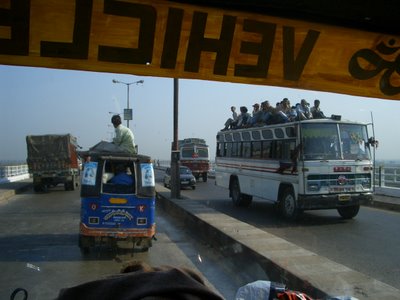
We got up at 4 a.m. the following morning and jumped in the bus. Bhanteji led several meditations until it became a suitable hour for breakfast. We stopped at a very plush cafe and ordered masala chais all the way around, and after offering food to the venerable bikkhu, we tore into the bags of noodles and veggies that the monastery had prepared for us as the roar from the road outside began to pick up. It is wonderful staying at these monasteries-- they delight in being able to provide assistance to true pilgrims walking in the Buddha's footsteps and following his path of mental purification. They expect nothing in return, though we would give dana for the room and board when we left. We continued on the road, with the front seat left to me, where I found a little too much enjoyment in the vast scenes of India and Indian life stretching before me, and before the lens of my digital camera. Bhanteji, sitting behind me, began to point out good shots for me to take. At one point I took the picture of a water buffalo blocking our progress on the road, and he turned to me incredulously and asked, "you don't have these animals where you come from?" "Not really," I said, "and they certainly don't hold traffic up if we do." Here is one photo he wanted me to take of all the people sitting on the top of the bus:

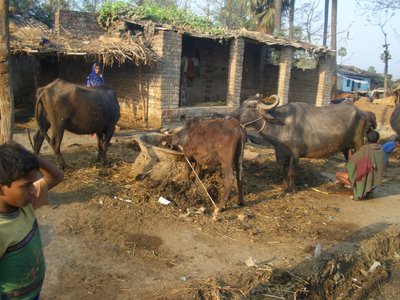
And here's a photo of the typical kinds of towns we'd pass through...

We made a couple of stops in the old town of Vaishali, and visited places that even local transport no longer goes to. Five years after the Enlightenment in Bodh Gaya, Buddha came here, the capital of one the first republican states in the Ganga. It is bound by the hills of Nepal on the north and the river Gandak on the west.

The Lichchavi nobility came to receive the Enlightened One with a cavalcade of elephants and chariots bedecked with gold. As he set foot on the soil of Vaishali, lightning and thunder followed by a heavy downpour purged the plague-infected city. The Buddha preached the Ratna Sutra to those assembled, and eighty-four thousand people embraced his teaching. Later, the Buddha's foster mother, Mahaprajapati Gautami, along with 500 Sakyan women made a pilgrimage by foot from Kapilavastu to Vaishali, seeking to join the Order.

Vaishali is also renowned as the place where the Buddha delivered his last sermon. Following a severe illness, he asked Ananda to assemble all the bhikkhus. He told the gathering that the Mahaparinirvana (final extinction) was imminent. He asked the monks to spread the Dhamma in order to bring about the good and happiness of many.

We first meditated at a spot where there were some Buddha relics, walking past beggars and Hindu "caretakers" trying to make money for arranging our shoes outside (which I couldn't leave anyway since mine would melt if left out in the sun-- which made for an interesting two weeks for me!) Again, once we started sitting, they gathered around us and watched us the entire duration, wide-eyed and jaws on the ground. As we did at many places, we began and ended the sitting by following Bhanteji around the circumference of the stupa, hands clasped and repeating some Pali after him. I then took off my hat and camera, and unpacked the meditation items from the bag I bought in Bohdgaya. This included a very small cushion (that was actually smaller than the area of buttocks), a mosquito net and shawl (used as padding for the legs during the day and as protection from cold and insects at dawn and dusk), an umbrella if the sun was out, and usually a water bottle supporting one leg. Every single item had a use, and most had two or three.
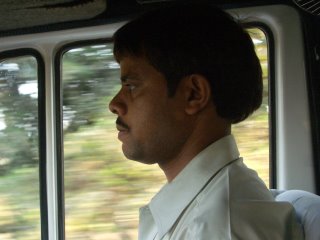

For lunch, we casually walked over to a Japanese owned building, the men and women told to wait in separate sitting rooms, and had some disgusting Indian Chaat Street Doritoes until the food arrived with just a few minutes to finish it. Later I found out that we had made plans to have food elsewhere but these fell through, and it looked like lunch would not take place today. Somehow, through many complicated details I did not understand, Mahindra our driver (see photo) investigated this place, and food was prepared for all of us just in time, with Mahindra also behind the kitchen helping. He understood and respected our noon deadline and was now caring for us-- the vibes were spreading. I remarked to Kedaar how so much on this trip seemed to come about like this... doors would open where none seemed to exist, providing all our necessities for us. He said it was rather usual given what we were doing. One time we came into a town where we had not been able to reserve any lodging whatsoever, and we were arriving at 10 pm. Bhanteji smiled and said, "Don't worry. Let us meditate. Leave it to Dhamma. Dhamma will take care of us." And practically speaking, it did at every turn.


Our next stop was at a former nunnery that also happened to have the oldest preserved Ashokan column still in its original place (think I got that right-- actually saw the gigantic three lions and Wheel of Dhamma in a Sarnath museum-- unbelievable!!!). We sat here for some time in the sun as all the beggar children stopped to peer at us for most of the time. Some of them stopped begging and sat down to watch us fascinated, while Bhanteji had to yell at one who would make noise and walk on the structures-- this also seemed to happen in many other sites. Also found a well and was assured by Kedaar and Bhanteji it was safe to drink from. Had some doubts but also felt up to now I hadn't any real illness in India, perhaps I might try... when traveling always a very hard line to find the difference between being safe enough and then too safe... so had a couple sips to test myself. We washed our feet and continued on our way... here are some photos of this trip, click here!


We made another stop for juice at a small town where we had to make a phone call regarding our night's accommodations, but only fruit was to be found. This proved to be one of the most unusual stops of the trip. As Gilad, Anita, Alastair, and Janet and I began to walk down the dirt street, we soon had a few men and boys stopped and staring at us. As the minutes passed, this number grew steadily, until we found ourselves in the middle of a circle with a few dozen people outside. Everyone now walking or biking past saw this and though they'd better also come over to watch the show. We even started dancing to the very loud Hindi music blaring from somewhere. Eventually we got back on the bus, and felt like the Beatles-- several dozen people on all sides staring into our windows... and off again.


We drove for some time until reaching Kushinagar. This was where the Buddha passed away, the final "Parinibbana". We got another whiff of the death of his teachings in India as well. We wanted to stay at the Thai monastery, and they also wanted us to stay. But the local businesses had complained that they were taking visitors away from their establishments and were preparing to sue. For this reasons, legally, they didn't feel comfortable accepting us. We felt we were pilgrims, and had been staying at monasteries and Vipassana centers the entire trip, and the vibe at a hotel would be a severe change-- it was all about this, and money was insignificant. No matter. We drove around to Tibetan, Korean, and other monasteries, but no luck. We finally settled at a hotel as about 10 p.m. approached, which most of us later agreed was the most unpleasant and crummy hotel we had ever stayed at. A release valve must have been struck, as most of the males spent a fair amount of time engaged in a lengthy argument demanding that we pay half the costs for the room only. It was simply unprincipled to pay more, we said. Some sheets were burnt and torn, mosquitoes flew freely into the room, the beds almost broke upon touching them, there was no hot water, and during one shower I found hundreds of ants covering my towel. The next morning we paid half the costs and drove off, past the dozens of Indian men gathering outside and making a racket.

We woke before 4 a.m. and, the Kushinagar grounds being closed, meditated at the pagoda by the Burmese monastery. I kept falling asleep and wondered if I'd have been better off in bed. I asked Kedaar. "Even the fight you make is so important," he said, and it made sense. We had breakfast at the Thai monastery (they said they could feed us, even if they couldn't house our party), and it was one of the largest areas I'd seen yet. The architecture was in the elegant Thai style and there were many temples, meditation halls, bungalows, eating halls, and residences on site. It is ironic-- so many Indians have no understanding or concern for Buddha's teachings, but there is an incredible revival of Buddhism going on in Northern India. This started perhaps several hundred years ago when members of the British Raj began to discover these sites and decipher who the Buddha was and what he taught. So little was known (and the Hindu pundits purposely misled them because what had they to gain by revealing this man who taught self-purification-- all this meant to them was a loss of income by people coming themselves out of misery, rather than paying sums of money for elaborate rites, rituals, and sacrifices to take place) that many believed he had come from Ethiopia. A fantastic book that chronicles this is "The Search for the Buddha" by Charles Allen. Modern Buddhist studies actually rests on the hard work by these Westerners. And today, Westerners are also playing an enormous role, through Vipassana and other practices, to bring back these messages. On the other hand, non-Indian Asians, from Burma through Japan, have begun massive construction projects in all of the important holy sites. None of these existed as they did ten years ago, and mark my words, ten years from now the development is going to be stunning...


We then toured around the grounds of Kushinagar, paying homage, meditating, circambulating and chanting, leaving one place for another when a noisy group of Japanese or the infamous white Sri Lankans came, and I realized that everyone else is coming with their own cultural variances of Buddha-- our group was nearly alone in coming just to sit, to observe, to purify. Sometimes, I must say, in longing I looked at the other groups and thought about how much easier their yatra looked! One small room marked the spot where his Parinibbana actually took place, and a large Buddha statue from the 5th century showed him lying on his side. Bhanteji pointed out the face changed as you walked around it-- from one angle you saw suffering, from another joy, from the final, peace.

We went back to the Thai monastery for a delicious lunch, but I was starting to feel some fever pains of weakness in my body, so I couldn't properly appreciate the beautiful aesthetics of the low tables or the chanting of monks and nuns just as the noon hour struck. Janet and Alastair were also feeling a tad squeamish, so they stopped in the Thai's free clinic, waiting with the poor and elderly and babies, and after they got Western medicine, we were on our way.


I was happy to leave Kushinagar. Given that the hotel was unpleasant and I was starting to feel poorly, I also sensed the entire place felt of death and demise. I realized how much the spread of Dhamma seemed to be in the very air in Sarnath, and how his ultimate realization pervaded everything in Bohdgaya-- natural that this was, then, death. I looked forward to leave it though, this time at least, and find rebirth and growth in Lumbini, our next destination, where Gotama was born... here are some photos!

And some photos of the Thai dog and monastery...


A drive through Bihar


We are up at 3.30 a.m. the following morning and spend many hours sitting on the grounds before leaving. This is probably the most holy of all the sites, and very hard to describe. The Maha Bodhi society has done a wonderful job of preserving the site and not charging any money to pilgrims, but it has had to fight the extremely greedy Hindu government of Bihar to do so. As one walks around the main temple, the land is dotted with dozens of Ashokan pillars, arahant stupas, gifts and dedications from Asian countries, and many other items. We meditate in a hall where a Buddha relic is kept, and view the seven areas where Buddha spent one week each after Enlightenment, contemplating and understanding the laws of nature to a subtler degree. In our mosquito nets we sit just outside the small golden pavilion which marks the very spot underneath the Bodhi tree where Nibbana was attained. As time passes, more and more pilgrims start to arrive, until we are overwhelmed yet again by the 100-person strong Sri Lankan troupe, dressed entirely in white, and their head monk who chants into a loudspeaker (!) and they repeat after him. Suddenly this small golden area is opened for a short time, and we all head in here to briefly pay homage.


By breakfast we head back to the Burmese monastery and eat across the street. We have our choice between the Original Pole Pole Restaurant and New Pole Pole Restaurant. They are side by side and I can't remember which one we choose. They serve pseudo-Western meals such as banana pancakes and honey but these are always far more dangerous than just getting some iddli or rice pudding. The food takes an enormous amount of time to prepare... we are ten people and there is but one cook and a couple burners. Ah well. We serve Bhanteji, each of us taking turns at offering something in his begging bowl. He thanks us in turn, saying "get merits, get merits," then chants a brief metta and asks us to make an aspiration having made an offering with a pure heart to a monk. This is the usual practice for these two weeks of yatra.

We get on the bus and head into the much more dangerous Rajgir. Bihar is by far the poorest of all of India, and through some drives we see why. There is no infrastructure anywhere, and the only means of surviving in many of these places seems to be extremely hard physical labor, such as hauling rocks on one's back all day or pushing cartloads of bricks. There are many dacoits as well, and we must pay off some of them at roadblocks (though I was told they are actually government employees-- never did figure that one out)

During the lifetime of the Buddha Rajgir was the capital of the powerful Magadhan kingdom, ruled by the virtuous King Bimbisara. The hills and caves surrounding Rajagriha were home to spiritual teachers, ranging from the materialism of the early Charavaka school to the metaphysics of Upanishadic philosophers. Today, however, Rajgir is hardly even a village. We are told that we will climb two more hills on this day. But this time, we find out the climbs are far longer and sun a good deal hotter. It takes a great deal of effort, and each of us makes the climb with a full bottle of water and a cloth covering or umbrella to protect against the sun's rays. The first hill has many caves that Buddha, Ananda, Sariputtra, and Mogallana stayed in. Before making the ascent, we stop at a horrible roadside eatery, the worst of the trip, where the kitchen peers out at us like a dark dungeon with flies on every speck of food and pot. To make matters worse we are also grossly overcharged and must engage in an argument with the management before leaving.


At every site, in Rajgir and every other pilgrimage site we visit, we pay homage to its importance. No one is required to do this, but we all can sense that it is deeply meritorious and beneficial to do so. Thus for us Westerners, each of us must continue his own confusing battle with the bulky ego. We are told the correct way for paying homage is to clasp one's hands together, touch them to the forehead, then chest, then press hands, elbows, and forehead to the ground. This is done three times, one each for Buddha Dhamma and Sangha. On a deeper level, Bhanteji asks that we are aware of sensation as we do this, any sensation, and perhaps think of another three characteristics: anicha, anatta, dukkha. That is, to recognize the impermanent nature of all things, the constant change always taking place; to realize that this transience must mean there is no "I", no "me"; and finally, to remember the suffering and pain that always must come every time we mistakenly start to identify this bodily and mental structure and all its attachments and cravings and aversions with "my." Gilad's struggle includes the fact that in Jewish faith, it is very important than no one bow before any other person or image-- this was a strong belief he grew up with. As for me, it is excrutiating sometimes. I feel I must go the full distance-- I have come so far to see these sites, to not honor them properly feels very wrong. But at the start of the yatra, with all the homage I am paying, the resevoirs of doubt and negativity that come up are brutally strong. I try to smile and know the sensation is not going to last, and not go deeper into the matter. It is challenging... I also remember Malcom X's powerful description of the first time he ever bowed while in prison. He could barely bring his body to do it-- something was screaming out trying to stop it. Even after many years of following Islam, he also struggled with bowing on his trip to Mecca as well, and compared his difficulty as an American with the Middle Easterners.

We skip the primitive ski lift chairs and make our way up the very steep hill, past prostrate elderly beggars in rags and young children who cling to you several steps or more asking for pens, money, even my water bottle, anything. It was at this place that Gotama's cousin Devadatta tried to kill Buddha by hurling a rock down the mountain, that only succeeded in injuring his foot. Here is a further description of the area...

"The most important of all associations of the Buddha with Rajgir is that with Vulture's Peak, a small mountain just outside the city. Here, sixteen years after his enlightenment, he set forth the second turning of the wheel of Dharma to an assembly of 5,000 monks, nuns and laity, as well as innumerable bodhisattvas. This collection of teachings, which extended over twelve years, includes the Saddharmapundarika Sutra and the Surangama Samadhi Sutra, as well as many Prajna-paramita Sutras, which, as the Buddha himself told Ananda, contain the very essence of all his teachings.

When the Chinese pilgrims visited Vulture's Peak they found the summit green and bare. Fa Hien mentions a cave and Hsuan Chwang a hall slightly below it, where the Buddha is said to have sat and preached. Here also he once reached through the mountain with his hand to calm Ananda, whose meditation was being disturbed by Mara in the form of a vulture. Before the cave were the walking and sitting places of the previous buddhas, and a stupa where the Saddharmapundarika Sutra was taught.

King Bimbisara built a causeway leading up to the hill. At the foot of the hill was Amaravana, the mango grove offered to the Buddha by the physician Jivaka. The remains of what was once a monastery may still be seen here. According to Hsuan Chwang, at one time on Vulture's Peak there was a monastery occupied by many meditators and several arhants. "

And here are a couple photos of a cave we sat in, and the top of Vulture's Peak, where I believe Buddha used to come...

Our second hill is even more challenging to climb. We start by walking past a small Hindu temple and hot springs complex. The higher we ascend, the more the view opens up. Just when it looks like it can't possibly get any more splendid, it does. We must pause several times to not exhaust overselves. Many times Bhanteji orders to stop, continue standing, close our eyes, and observe respiration or sensation. We do this and move on. When we reach our destination, it is as if we are on the wing of an aircraft. There is a small ledge and a giant drop-off cliff below. We find a cave and meditate here, enjoying an extremely powerful metta session. This is the place of the Sangayana. After the Buddha's death, the Sangha came here to chant all of his teachings so that they would be remembered for all posterity. Last year's yatra, I am told, Kedaar and Bhanteji meditated here all night.


Our final stop is the Bamboo Grove. This was donated by King Bimbisara. It is also the place where his wife, Queen Malika, ordained as a nun, and where Buddha first spotted his two chief disciples, Sariputtra and Mogallana. We meditate here and after we finish, a Thai couple approaches us, pays homage to Bhanteji, and offers dana in the form of money, which he refuses. This is a very common occurrence through all our yatra-- people stopping to prostrate themselves before Bhanteji, and he recites a short metta chanting wishing them happiness. It is really quite wonderful and pure to behold.

We stop in Nalanda, but are not able to find our way inside. We settle on fresh orange juice and sugar cane water after a fierce round of negotiations. It feels like it is the ten of us in this area and about 10,000 beggars in all directions. We see a Thai monastery/university across the river and walk around here, seeing the young Thai monks smoking and playing hackysack in their scivvies. The sun is setting and this is a very peaceful place here. We stare across the river at Nalanda, finding the building where Sariputtra was born.


We pull into another Thai monastery. This place is exquisite but still very much in the process of building. Once I brushed my teeth in the sink in my room, only to realize that nothing was connected, the hole in the sink emptied on the marble floor below! The danger of this area requires that they have a roaming guard with a rifle, patrolling the grounds all night, as you can see in the photo with Gilad next to him. We want to go back and have a sit at Bamboo Grove, but are told we must not due to safety issues. I am tired all over, my laundry has been dirty for days on end and I can't remember my last shower. I somehow drag my body to complete the necessary tasks before dropping asleep. With no mosquito nets over the beds, I hope I'll be able to sleep soundly, which I do.

For photos of this area, go here!

Wednesday, March 15, 2006

Bohdgaya and environs

We pull into Bohdgaya at about 2.30 a.m. Even the beggars are asleep. We can't find a way into the main grounds, so we walk past the threatening packs of wild and mangy dogs, sitting down just outside the gates. We fix our mosquito nets and I can barely observe breath with the constant hum (and at times roar) or mozzies outside my ear. It took me several minutes upon sitting down to assure that there was absolutely no opening in the net and all sides are covered. This also makes me sit longer with pain on the hard concrete-- changing positions increases the chance the net will also shift. Several mozzies bite me though net and pant both , and my knees end up with some big welts. As we sit many of the dogs end up getting attracted to our vibration and come over to lay near us. After some time Bhanteji asks us to remove the nets so as to see our faces, we do so and he gives a discourse on correct behavior around monks and nuns. As he is speaking one dog comes toward him and continually tried to nudge him warmly-- over the course of the next couple weeks such behavior from animals and humans alike to our group will become the norm... and at about 4 am the gates are opened, and with some monks, nuns, and Asian pilgrims who have gathered, we entered the grounds together. We go to the very spot where Gotama was enlightened and sit here. Having only been given anapana to this point, Bhanteji gives us Vipassana for the first time here at this place-- it is extremely powerful and I can barely work. The whole thing is intense and surreal-- the latter a word I don't really like using much because it seems a lazy and intellectual way of saying you can't put your finger on what was different or special about the experience. We leave to catch the 6 a.m. breakfast we have reserved at the Thai monastery, which being on Thai and not Indian time, has expressed a little displeasure towards our group (through poor Lek of course) that we have consistantly not been able to arrive when we said we did, and their preparations for a clean room and food went for naught. The dogs come back to welcome us, they walk with us to the bus and often jump just ahead of us and then stop, forcing us to change our path and go around them-- this happens so many times it bring much laughter.

We eat at the Thai monastery, serving Bhanteji his one meal of the day before we start. It is challenging for me at times. When I feel humble and reverential and happy I can't enjoy serving him enough, and my mind is in a very right space. But sometimes my Western conditioning comes up so strong. I am hungry and tired a bit negative and I just want to ignore everyone and everything and eat. But somehow I know I must serve, and do it with no negativity anywhere in my heart if I wish to benefit from an actual meritorious deed, though everything Western in me is screaming and cringing in resistance. I don't know whether to force myself to do something and observe the unpleasant sensations which I think shouldn't be there, or respect this part of myself and stay in the background. I do the former, feeling that the greater effort I put in now, the more I will benefit later. The ego gets in my way and becomes very hard indeed to reconcile... giving up its attachments surely seems the wise way to go, but it can be tough eh!

After washing up we all wonder how we would ever get through this day of intense sightseeing and meditation, and survive that night when we would not sleep but spend the entire time sitting within the gounds of Bohdgaya. Our condition was best epitomized by Alastair's shaving experience. The vast chunks of growth he missed and left splattered around his face was impressive as it was stunning... merely the outer manifestation of what most of us were experiencing.

We stopped at some Japanese monastery grounds first to admire a giant Buddha that looked to be an exact replica of the one in Kamakura, Japan. Many Japanese Buddhist buildings were in this area, and the aesthetics were nicely Japanese as well. To get from the bus to Buddha we must wage a miserable battle with the persistant beggars and postcard sellers who hound us relentlessly from before we even open the door to the moment before we drive away. Just as the scorching sun begins to blast its furnace, the bus drops us off at some rice and wheat fields, and led by Bhanteji, we negotiate the very narrow paths between the paddies. Again we are accosted by streams of beggars, all of them either very young or very old, and all looking like they are on their last days, missing teeth and wearing rags for clothes, dirt emeshed in hair, with withered hair and figures. The despair is overwhelming and such a contrast to the peace that the Buddha taught in this very place. How to put these two thoughts together I don't know, and struggle with for some time. We eventually get to a small building where we find a couple other pilgrims and monks, and find this was the very spot where Gotama discovered that harsh ascetic practices alone could not give way to liberation, and he accepted a milk rice dish from a village girl, Lady Sujata, whose house still exists. Once he decided to opt for the Middle Path, he moved to the Uruvela forest near the village of Senanigama, which is where we now found ourselves. We meditate here for some time, the other Indians coming to stare at us open-jawed from start to finish. We sit before a small description of the place and a Disney-like representation of Gotama receiving the food. As we get up to leave and slip into our shoes, the Hindu "care-takers" begin to pester us for money. Here they are on this sacred earth and all they can think of us is more ways to take money from gullible travellers-- something we will see time and time again as the days pass... Below is a photo of some of the children begging from us, these two were contented with just a photo...

And here is where Gotama ate his first rice meal...


We are then led across this incredible wasteland that vaguely resembles some of the lonely stretches I've driven across in Utah. It's pretty desolate here too, but this soon changes (doesn't everything!) into a real oasis of lush green trees in the middle of it. We are told this was around the area (one of many spots) where Gotama practiced his austeries. We meditate here and are again accosted by the Hindus trying to get a few rupees off of us. The walk and drive back to Bohdgaya gets us into the central area and Lonely Planet recommended Om restaurant. We order just about everything we see first as we walk in, though due to their slow kitchen we have about 7 minutes to each lunch. Although the menu boasts everything from calzones to wonton soup to katsudon, just about everything on it tastes almost identical. I use their toilet before leaving, which is, by far, the most amazingly disgusting toilet I have ever experienced in my entire life. Not wholesome to tell in detail here, ask me later if you are curious...

After we finish we make a quick stop at the bank, and are trying to buy some bags to carry our meditation belongings with us, we are rushed in the bus and wisked away on an hour drive to Dungeswari. Look at this photo of Alastair and Gilad at the bank and you can discern our state fairly well at this point... Prior to enlightenment, the Bodhisatta was staying on the other side of the Neranjara river in a cave. This cave is on a hill, now known as the Dhongra hill, and here he was practicing self-mortification and eating just a grain of rice a day for six years. It is important for us to leave sooner as we are heading into rather dangerous areas and must be out by nightfall-- again, how much changes in 2500 years. This is really in the middle of nowhere, at least in modern times. We pass through small towns until even the towns disappear, and find ourselves in a rather desolate areas with few trees growing, and beggars beseiging us once again. We climb a hill and on top come to a cave, where we sit for some time. Knowing the heat we have braved to get here, Bhanteji chants and then gives us brief instructions reminding us that even our heat and sweat and fast heartbeats are also anicha, to observe these with absolute equanimity. We sit before a golden statue of Gotama with his bare bones showing. Upon leaving more Hindus ask for money. I pass the Tibetan prayer flags and use the toilet-- this one is like one of those amazing Old West cartoons with the outhouse dangling over a cliffside-- this is for real, the hole in the toilet going over a steep cliff!

We go back down the hill and our bus takes us to another series of steps to climb, called Gayasisa, or Gaya Hill. As with the previous place, the view of the towns and land below is incredible. This is where Buddha found Kassapa and his three brothers, who had 1000 fire-worshiping ascetics with them. Kassapa was convinced he was an arahant, and when Buddha revealed to him he was able to read his mind, his arrogance was shattered and he and his whole retinue became disciples. This happened soon after Buddha's enlightenment, and the event shocked the local communities and kingdoms. He said these words (which T.S. Eliot later used for The Wasteland):

"All things are on fire; the eye is on fire; the body is on fire; the perception of the eye is on fire; the impressions received by the eye are on fire; and what ever sensation originates from the impressions received by the eye are also on fire. And how are these things on fire? Lust, anger, and illusion—these are the fires that consume the eye and the other senses and the mind. This is why the wise man experiences disgust for the things of the senses, rids himself of desire for the things of the senses, and so removes from his heart the cause of suffering. "

We sit here until it gets dark, and then Bhanteji reads a letter from a German Vipassana student who will come back to India and ordain with him. We make our way back to the bus and get to the Burmese monastery, where we are staying, for a short rest before our all night meditation at Bodhgaya. But the hours keep getting away, and there really remains so little time for rest, so we go to make a formal application for staying overnight in the grounds (they lock the gates and it is impossible to leave until 4 a.m.), we get some requisite chocolate and juice, and just as we enter, we find out that it is not possible. Now many monks from many Asian countries are in the process of chanting the entire Tipitika, it is taking several months, and they are not permitting it until the project is done-- sadly for us, this will be in just a few days, but we are too early. So, we head back to the monastery and actually get a few hours of bed-sleep.

Here are pics of Bohdgaya, click here.